
Contents
- 0.1 Introduction
- 0.2 Quick Answer: Is MBBS Abroad After NEET Failure Worth It?
- 0.3 Key Takeaways
- 0.4 Why Are Students Choosing MBBS Abroad After NEET Failure?
- 0.5 What Does “MBBS Abroad” Actually Mean?
- 0.6 Is NEET Mandatory for MBBS Abroad?
- 0.7 Smart Alternative or Risky Decision? The Honest Comparison
- 0.8 Advantages of Studying MBBS Abroad After NEET Failure
- 0.9 Risks of MBBS Abroad Students Must Know
- 0.10 Best Countries for MBBS Abroad After NEET Failure
- 0.11 How to Choose the Right MBBS Abroad University?
- 0.12 MBBS Abroad vs Private MBBS in India
- 0.13 Who Should Consider MBBS Abroad?
- 0.14 Who Should Avoid MBBS Abroad?
- 0.15 What Is the Future of Foreign Medical Graduates in India?
- 0.16 Expert Insight: The Biggest Mistake Parents Make
- 0.17 People Also Ask
- 1 Conclusion
Introduction
Every year, lakhs of Indian students dream of becoming doctors. Yet, only a small percentage secure a government MBBS seat in India. For many students, NEET failure feels like the end of the road. Parents panic, students lose confidence, and confusion takes over.
But here’s the truth most people don’t realize:
Failing to secure a good NEET rank does not mean your medical dream is over.
In recent years, thousands of Indian students have chosen to study MBBS abroad as an alternative pathway. Countries like Russia, Georgia, Kazakhstan, Uzbekistan, and the Philippines have become popular destinations because of affordable tuition fees and easier admission processes.
However, an important question remains:
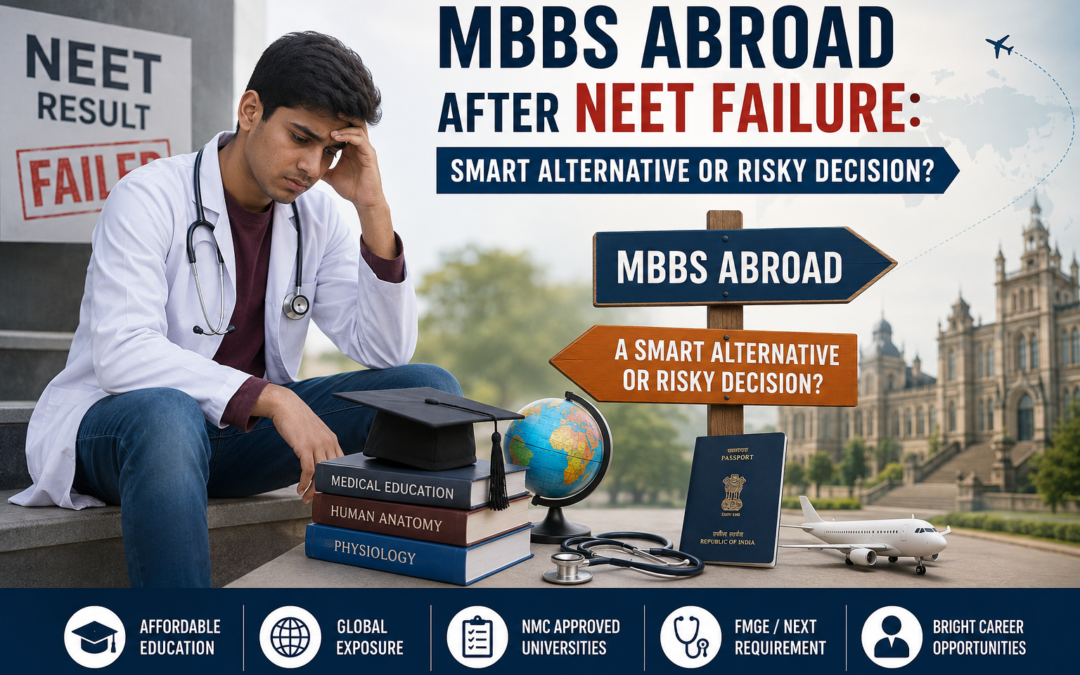
Is MBBS abroad after NEET failure a smart career move or a risky shortcut?
The answer depends on multiple factors university quality, FMGE/NExT preparation, budget, career goals, and choosing the right consultancy.
This guide explains everything students and parents need to know before making a life-changing decision.
Quick Answer: Is MBBS Abroad After NEET Failure Worth It?
Yes, MBBS abroad after NEET failure can be a smart alternative, if students choose a recognized university, understand NMC regulations, and prepare seriously for licensing exams like FMGE or NExT.
However, it becomes risky when students:
- Choose low-quality universities
- Ignore NMC guidelines
- Depend only on consultants without research
- Underestimate language and cultural challenges
The key is making an informed decision instead of an emotional one.
Key Takeaways
- NEET qualification is still mandatory for Indian students pursuing MBBS abroad.
- Studying abroad is often cheaper than private medical colleges in India.
- FMGE/NExT licensing exams are crucial for practicing in India after graduation.
- University recognition matters more than low fees.
- Countries like Georgia, Russia, Kazakhstan, and Uzbekistan are popular due to affordability.
- Students must evaluate ROI, safety, clinical exposure, and career goals before deciding.
Why Are Students Choosing MBBS Abroad After NEET Failure?
Limited MBBS Seats in India
India has a severe imbalance between medical aspirants and available seats.
Current Reality
- Over 20 lakh students appear for NEET annually
- Government MBBS seats remain limited
- Private colleges often charge ₹60 lakh–₹1.5 crore
For middle-class families, private medical education in India becomes financially impossible.
As a result, many students explore affordable MBBS abroad options.
What Does “MBBS Abroad” Actually Mean?
MBBS abroad refers to Indian students pursuing medical education in foreign universities approved by the National Medical Commission (NMC).
After completing the course, students must clear:
- FMGE (currently)
- NExT (future licensing system)
to practice medicine in India legally.
Is NEET Mandatory for MBBS Abroad?
Yes, NEET Qualification Is Mandatory
Many students misunderstand this point.
Important Clarification
Even for studying abroad:
- Students must qualify NEET
- NEET validity for abroad admission is generally 3 years
- Without NEET qualification, students cannot practice in India later
This rule is enforced by the National Medical Commission (NMC).
Smart Alternative or Risky Decision? The Honest Comparison
| Factor | Smart Decision | Risky Decision |
|---|---|---|
| University Selection | NMC-approved university | Unrecognized university |
| Budget Planning | Transparent fee structure | Hidden charges |
| Career Preparation | Early FMGE/NExT preparation | No licensing exam strategy |
| Clinical Exposure | Strong hospital training | Weak practical training |
| Consultancy | Ethical guidance | Misleading promises |
| Language Support | English-medium programs | Language barriers ignored |
Advantages of Studying MBBS Abroad After NEET Failure
1. Affordable Medical Education
One of the biggest reasons families choose MBBS abroad is affordability.
Cost Comparison
| Option | Approximate Cost |
| Government MBBS in India | ₹1–10 lakh |
| Private MBBS in India | ₹60 lakh–₹1.5 crore |
| MBBS Abroad | ₹18 lakh–₹45 lakh |
For many families, studying abroad becomes financially realistic.
2. Easier Admission Process
Unlike India’s intense cutoff competition:
- Many foreign universities offer direct admission
- Donation fees are usually absent
- Admission is based on NEET qualification and academics
This reduces stress significantly.
3. Globally Recognized Degrees
Several universities are recognized by:
- NMC
- WHO
- ECFMG
- WFME
This opens international career opportunities.
4. International Exposure
Students gain:
- Multicultural experience
- Independent living skills
- Global medical exposure
- Better communication abilities
These experiences often improve personal growth and confidence.
Risks of MBBS Abroad Students Must Know
1. FMGE Passing Challenges
This is the biggest concern.
Many foreign graduates struggle to clear FMGE because:
- Some universities provide weak clinical training
- Students depend entirely on university teaching
- Lack of self-discipline affects preparation
Important Insight
Students who prepare consistently from Year 1 generally perform much better.
2. Fake or Low-Quality Universities
Some consultants promote universities based on commissions instead of quality.
Warning signs include:
- Extremely low fees
- Guaranteed FMGE claims
- No transparent accreditation details
- Lack of Indian student support
Always verify university recognition independently.
3. Language Barriers
Although MBBS programs may be English-medium:
- Local patients often speak native languages
- Clinical interactions can become difficult
Students must be mentally prepared to adapt.
4. Homesickness and Cultural Adjustment
Living abroad at 17 or 18 years old can be emotionally challenging.
Students may face:
- Climate differences
- Food adjustment issues
- Loneliness
- Cultural shock
Parental emotional support becomes very important during the first year.
Best Countries for MBBS Abroad After NEET Failure
Georgia
Why Students Prefer Georgia?
- Modern infrastructure
- European education standards
- Better safety
- English-medium programs
Ideal For
Students seeking balanced education quality and lifestyle.
Russia
Key Advantages
- Long-established medical universities
- Affordable tuition fees
- Strong theoretical education
Considerations
Climate adaptation can be difficult for some students.
Kazakhstan
Why It’s Popular?
- Budget-friendly
- Growing Indian student community
- Simpler admission process
Watch Out
University selection matters heavily.
Uzbekistan
Emerging Destination
Uzbekistan has become popular due to:
- Lower costs
- Easier communication
- Improving medical infrastructure
Philippines
Major Advantage
US-based medical curriculum structure.
Best For
Students planning future opportunities in countries like the USA.
How to Choose the Right MBBS Abroad University?
Checklist for Parents and Students
Before finalizing admission, verify:
University Recognition
Check:
- NMC approval
- WHO listing
- FMGE eligibility
Clinical Exposure
Ask:
- Which hospitals are attached?
- How many patient interactions happen daily?
Indian Student Support
Look for:
- Hostel facilities
- Food availability
- Student mentorship
FMGE Performance
Research:
- Previous FMGE passing trends
- Alumni feedback
Transparent Fee Structure
Confirm:
- Tuition fees
- Hostel fees
- Visa costs
- Hidden charges
MBBS Abroad vs Private MBBS in India
| Factor | MBBS Abroad | Private MBBS India |
| Cost | Lower | Very high |
| Competition | Moderate | Extremely high |
| Global Exposure | High | Limited |
| FMGE/NExT Requirement | Yes | No |
| Infrastructure | Depends on country | Varies |
| Clinical Exposure | University dependent | Usually better locally |
Who Should Consider MBBS Abroad?
MBBS abroad may be suitable for students who:
- Qualified NEET but missed Indian cutoff
- Cannot afford private colleges in India
- Are adaptable and independent
- Can stay disciplined academically
- Are willing to prepare for FMGE/NExT early
Who Should Avoid MBBS Abroad?
Students should reconsider if they:
- Expect an “easy shortcut”
- Cannot adapt to living abroad
- Are unwilling to self-study
- Choose universities based only on low fees
- Ignore licensing exam realities
What Is the Future of Foreign Medical Graduates in India?
The future remains promising for serious students.
India continues to face a doctor shortage, especially in:
- Rural healthcare
- Public health
- Specialist services
However, regulatory standards are becoming stricter. This means:
- Better universities will matter more
- Clinical competency will become essential
- NExT preparation will play a major role
Students focusing on quality education and long-term skill development can still build successful careers.
Expert Insight: The Biggest Mistake Parents Make
Many parents focus only on:
- Lowest fees
- Fast admission
- “Guaranteed success” promises
But the smarter question is:
“Will this university help my child become a competent doctor?”
A cheaper university with poor training can cost years of career delay later.
Medical education should always be viewed as a long-term investment, not a short-term expense.
People Also Ask
Can I study MBBS abroad after failing NEET?
You must at least qualify NEET to pursue MBBS abroad legally and practice later in India.
Is MBBS abroad valid in India?
Yes, if the university follows NMC guidelines and students clear FMGE/NExT licensing requirements.
Which country is best for affordable MBBS abroad?
Georgia, Russia, Kazakhstan, and Uzbekistan are among the most affordable and popular options for Indian students.
Is MBBS abroad risky?
It can be risky if students choose low-quality universities or ignore licensing exam preparation. Proper research reduces most risks significantly.
Can MBBS abroad students become doctors in India?
Yes. After completing the degree and clearing required licensing exams, they can practice legally in India.
Conclusion
Failing to secure a medical seat in India does not mean the end of a doctor’s journey.
For many students, MBBS abroad after NEET failure becomes a second chance and sometimes even a smarter pathway. But success depends entirely on informed decision-making.
Students must:
- Choose recognized universities
- Understand NMC regulations
- Prepare early for FMGE/NExT
- Focus on skill development, not shortcuts
Parents should avoid emotional or rushed decisions and instead prioritize quality education, clinical exposure, and long-term career outcomes.
The right university can shape a successful medical future. The wrong one can create years of struggle.
So before taking admission, research deeply, ask difficult questions, and think beyond just fees.
Ready to Explore MBBS Abroad Options?
Speak with experienced counselors, compare universities carefully, and choose a medical pathway that matches your career goals, budget, and future aspirations.
FAQs
1. Is NEET compulsory for MBBS abroad?
Yes. Indian students must qualify NEET to study MBBS abroad and practice later in India.
2. What is the average cost of MBBS abroad?
The total cost generally ranges between ₹18 lakh and ₹45 lakh depending on the country and university.
3. Which countries are safest for Indian MBBS students?
Georgia, Russia, Kazakhstan, and the Philippines are popular choices with growing Indian student communities.
4. Is FMGE difficult for foreign medical graduates?
FMGE can be challenging, especially for students from poor-quality universities. Early preparation improves success rates.
5. Can students work abroad after MBBS?
Yes, depending on licensing exams and immigration regulations of that country.
Dream big global education an experienced MBBS abroad advisor before making your final decision.
A smart decision today can shape your entire medical career tomorrow.
Your MBBS dream is still alive you just need the right path.
Also check our other Blogs
Parents Worried About MBBS Fees?
Best Country for MBBS Abroad in 2026
Is MBBS Abroad Safe? Thinking It’s Risky
Great content! Keep up the good work!