
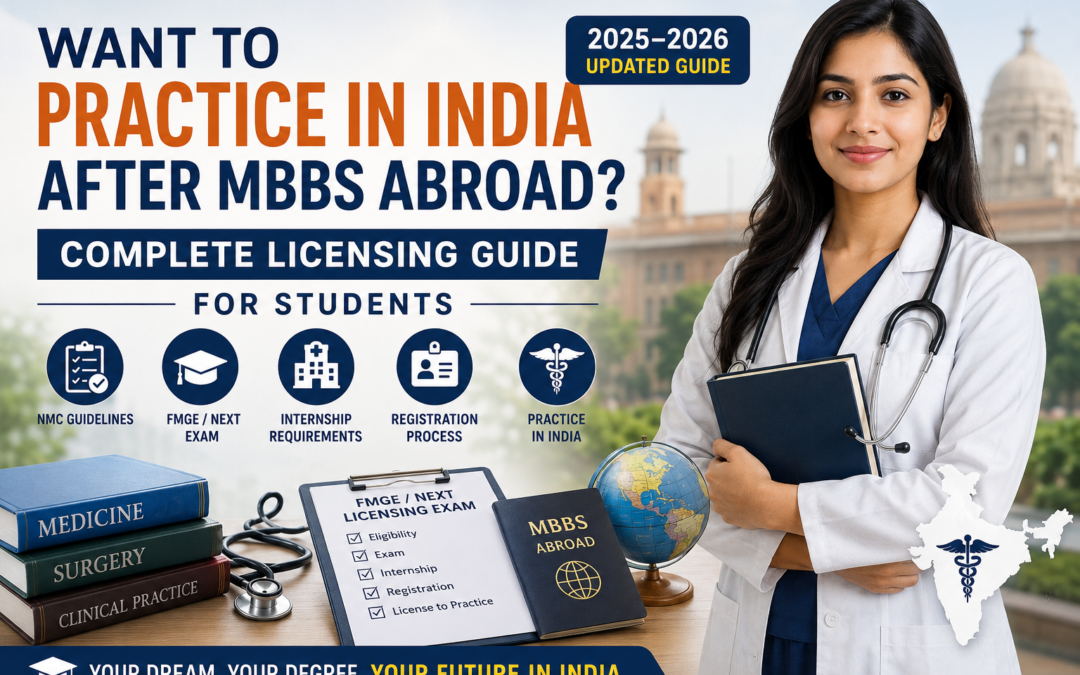
Many Indian students choose MBBS abroad because of high NEET competition and expensive private medical colleges in India. But here’s the reality most students realize too late:
Getting an MBBS degree abroad is only half the journey.
The real challenge begins when you return to India and try to get a medical license.
Every year, thousands of students come back with dreams of becoming doctors in India. Some succeed smoothly. Others struggle with licensing exams, internship issues, documentation problems, or universities not meeting NMC guidelines.
Based on recent student trends, one of the biggest mistakes students make is choosing a country only because the fees are low without checking whether the degree is valid for medical practice in India.
This guide explains everything you need to know about practice in India after MBBS abroad in 2025–2026.
Contents
- 1 Can You Practice in India After MBBS Abroad?
- 2 Why Licensing Matters More Than the MBBS Degree?
- 3 Latest NMC Rules for MBBS Abroad Students (2025–2026)
- 4 Key NMC Requirements
- 5 FMGE vs NEXT: What Will Happen in 2025–2026?
- 6 FMGE Passing Reality
- 7 What is NEXT Exam?
- 8 What Students Should Understand?
- 9 Step-by-Step Process to Practice in India After MBBS Abroad
- 10 Best Countries for Students Who Want to Practice in India
- 11 Russia
- 12 Georgia
- 13 Uzbekistan
- 14 Bangladesh
- 15 Kazakhstan
- 16 Hidden Costs Students Ignore Before MBBS Abroad
- 17 Mistakes Students Make While Planning to Practice in India After MBBS Abroad
- 18 Reality Check: MBBS Abroad is Not an “Easy Shortcut”
- 19 How to Improve Your Chances of Clearing FMGE/NEXT
- 20 Focus on Clinical Subjects
- 21 Use Indian Standard Resources
- 22 Practice MCQs Regularly
- 23 Choose Universities With Good Hospital Exposure
- 24 MBBS Abroad Fees vs Indian Private Medical Colleges (2025–2026)
- 25 Who Should Consider MBBS Abroad?
- 26 Internal Linking Suggestions
- 27 Final Thoughts
Can You Practice in India After MBBS Abroad?
Yes, Indian students can legally practice in India after completing MBBS abroad but only if they meet the regulations set by the National Medical Commission (NMC).
To practice in India after MBBS abroad, students must:
- Qualify NEET before admission abroad
- Study in an NMC-recognized university
- Complete the required course duration
- Finish mandatory clinical internship
- Clear FMGE or NEXT (depending on implementation timeline)
- Obtain registration from NMC or State Medical Council
If even one requirement is missed, students may face delays or rejection in licensing.
Why Licensing Matters More Than the MBBS Degree?
A foreign MBBS degree alone does not allow you to work as a doctor in India.
Your actual eligibility depends on:
- Licensing exam performance
- Clinical exposure
- Internship quality
- Documentation compliance
- University recognition status
This is why experienced consultants always advise students to think beyond “cheap MBBS fees.”
Latest NMC Rules for MBBS Abroad Students (2025–2026)
The Foreign Medical Graduate Licentiate regulations have become stricter in recent years.
Key NMC Requirements
1. NEET Qualification is Mandatory
Students must qualify NEET before taking admission abroad.
Without NEET qualification:
- Your foreign degree may not be valid in India
- You may face registration rejection
2. Minimum Course Duration
The MBBS program abroad should generally include:
- 54 months of academic study
- 12 months internship
Short-duration medical programs can create licensing issues.
3. Entire Course Must Be Completed Abroad
Students cannot:
- Transfer between multiple countries
- Study partially online
- Complete clinical rotations in unauthorized hospitals
NMC now closely verifies clinical training quality.
4. English Medium Instruction
The medical course should be taught in English.
This matters because:
- FMGE/NEXT exams are in English
- Clinical terminology understanding is critical
5. Internship Must Match Indian Standards
Many students underestimate this requirement.
NMC may reject internship completion if:
- Clinical exposure is inadequate
- Internship hospital lacks approval
- Training records are incomplete
FMGE vs NEXT: What Will Happen in 2025–2026?
This is currently one of the biggest concerns among MBBS abroad aspirants.
What is FMGE?
The Foreign Medical Graduate Examination (FMGE) is the licensing exam conducted for foreign medical graduates who want to practice in India.
Conducted by:
National Board of Examinations
Students must clear FMGE to obtain provisional registration.
FMGE Passing Reality
FMGE is considered challenging because:
- The syllabus is vast
- Many foreign universities lack clinical exposure
- Students often rely heavily on self-study
Average FMGE Pass Rates
Approximate trends from recent years:
| Country | Typical FMGE Performance Trend |
|---|---|
| Russia | Moderate |
| Georgia | Improving |
| Uzbekistan | Moderate |
| Kazakhstan | Moderate to Low |
| Philippines | Historically good but changing |
| Nepal | Relatively higher |
| Bangladesh | Higher clinical exposure |
Based on real student trends, universities with strong hospital training usually produce better FMGE outcomes.
What is NEXT Exam?
The National Exit Test (NEXT) is expected to eventually replace:
- FMGE
- Final year MBBS exam
- NEET PG entrance
However, implementation timelines have seen delays and updates.
What Students Should Understand?
Whether FMGE or NEXT becomes active first, one fact remains constant:
Students with strong clinical knowledge and proper training will succeed.
This is why choosing the right university matters far more than choosing the cheapest option.
Step-by-Step Process to Practice in India After MBBS Abroad
Step 1: Qualify NEET
Before joining MBBS abroad:
- NEET qualification is mandatory
- Keep scorecard safely for future verification
Step 2: Choose an NMC-Compliant University
Before admission, verify:
- University recognition
- Internship structure
- Clinical exposure
- Medium of instruction
- Degree validity in India
Step 3: Complete MBBS Abroad Successfully
Focus on:
- Clinical postings
- Practical learning
- Patient interaction
- Exam preparation from early years
Students who only study theory often struggle later during licensing.
Step 4: Return to India and Apply for FMGE/NEXT
Required documents generally include:
- Passport
- Degree certificate
- Transcript
- Internship completion proof
- NEET scorecard
- Eligibility certificate (if applicable)
Step 5: Clear Licensing Exam
After passing:
- Apply for provisional registration
- Complete internship if required
- Obtain permanent registration
Best Countries for Students Who Want to Practice in India
Choosing the right country can significantly impact your future licensing success.
Russia
Advantages
- Affordable tuition
- Strong academic history
- Many Indian students
Challenges
- Language adaptation during clinical training
- Harsh weather in some regions
Georgia
Advantages
- European curriculum
- Good infrastructure
- Growing FMGE performance
Challenges
- Higher living expenses than some Asian countries
Uzbekistan
Advantages
- Budget-friendly
- Increasing popularity among Indian students
Challenges
- University quality varies significantly
Bangladesh
Advantages
- Similar disease patterns to India
- Strong clinical exposure
- Better patient interaction
Challenges
- Limited seats
- Competitive admissions
Kazakhstan
Advantages
- Affordable fees
- Multiple English-medium options
Challenges
- Clinical quality differs between universities
Hidden Costs Students Ignore Before MBBS Abroad
Many agencies advertise only tuition fees.
But actual expenses include:
| Expense Type | Approximate Cost |
|---|---|
| Hostel & food | ₹80,000 – ₹2 lakh/year |
| Medical insurance | ₹10,000 – ₹40,000 |
| Visa renewal | ₹15,000 – ₹60,000 |
| Flight tickets | ₹40,000 – ₹1 lakh/year |
| Licensing exam coaching | ₹1 lakh – ₹3 lakh |
| Internship expenses | Varies |
Students should calculate the TOTAL medical education cost not just tuition.
Mistakes Students Make While Planning to Practice in India After MBBS Abroad
1. Choosing Based Only on Low Fees
Cheap universities with poor hospital exposure may create licensing problems later.
2. Ignoring FMGE/NEXT Preparation
Many students start preparation only after returning to India.
This becomes risky because:
- Concepts remain weak
- Clinical knowledge gaps increase
3. Not Checking University Recognition
Recognition status can change.
Always verify:
- NMC acceptance
- WHO listing
- Accreditation
4. Depending Completely on Consultants
Some students never independently verify information.
Always cross-check:
- Internship details
- Clinical exposure
- Student reviews
- Licensing success rates
5. Underestimating Language Barriers
In several countries, local language matters during hospital training.
Without patient communication skills:
- Clinical learning suffers
- Practical confidence decreases
Reality Check: MBBS Abroad is Not an “Easy Shortcut”
Many advertisements present MBBS abroad as a guaranteed path to becoming a doctor.
The truth is more balanced.
What Students Must Understand
MBBS Abroad Works Well For:
- Hardworking students
- Self-disciplined learners
- Students focused on licensing preparation
It Becomes Difficult For:
- Students expecting easy academics
- Those ignoring practical learning
- Students choosing poor universities
Based on real student outcomes, students who consistently prepare from the first year usually perform much better in licensing exams.
How to Improve Your Chances of Clearing FMGE/NEXT
Start Preparation Early
Do not wait until final year.
Focus on Clinical Subjects
Subjects like:
- Medicine
- Surgery
- Pediatrics
- Pharmacology
play a major role in licensing exams.
Use Indian Standard Resources
Many students combine:
- Foreign university classes
- Indian coaching platforms
- FMGE-oriented preparation
Practice MCQs Regularly
Consistent revision improves retention.
Choose Universities With Good Hospital Exposure
Clinical confidence matters more than memorization.
MBBS Abroad Fees vs Indian Private Medical Colleges (2025–2026)
| Option | Approximate Total Cost |
|---|---|
| Indian Private MBBS | ₹60 lakh – ₹1.5 crore |
| Russia MBBS | ₹20 lakh – ₹40 lakh |
| Uzbekistan MBBS | ₹18 lakh – ₹30 lakh |
| Georgia MBBS | ₹35 lakh – ₹55 lakh |
| Kazakhstan MBBS | ₹18 lakh – ₹35 lakh |
| Bangladesh MBBS | ₹30 lakh – ₹45 lakh |
This affordability is why MBBS abroad continues to attract Indian students.
However, low fees should never compromise licensing eligibility.
Who Should Consider MBBS Abroad?
MBBS abroad can be a smart decision for:
- Students with limited private college budget
- NEET-qualified students seeking alternatives
- Students ready for independent learning
- Families focused on long-term medical careers
It may not suit students expecting shortcut success.
Internal Linking Suggestions
You can internally link this blog to:
- “Highest FMGE Pass Rate Countries”
- “NEXT Exam After MBBS Abroad”
- “Affordable Medical Education Countries”
- “Best Countries for MBBS Abroad”
- “NMC Guidelines for Foreign Medical Graduates”
- “MBBS Abroad Fees Comparison 2025”
Frequently Asked Questions (FAQs)
Can I practice in India after MBBS abroad without FMGE?
Currently, foreign medical graduates generally need to clear FMGE until NEXT fully replaces it officially.
Is MBBS from abroad valid in India?
Yes, if:
- The university is recognized
- NMC guidelines are followed
- Licensing requirements are completed
Which country has the best FMGE pass rate?
Countries with stronger clinical exposure like Bangladesh, Nepal, and selected Georgian universities often show better student performance trends.
Is NEET mandatory for MBBS abroad?
Yes. NEET qualification is mandatory for Indian students planning to practice in India later.
Can I get PG admission in India after MBBS abroad?
Yes, after clearing the required licensing process and qualifying NEET PG or NEXT PG pathway.
Is MBBS abroad risky?
It depends on:
- University selection
- Clinical exposure
- Student dedication
- Licensing preparation
Poor planning increases risk significantly.
What is the biggest mistake students make?
Choosing universities purely based on low fees without checking licensing outcomes and hospital training quality.
Final Thoughts
The dream to practice in India after MBBS abroad is absolutely achievable but only with proper planning.
In 2025–2026, success is no longer just about getting admission abroad. It is about:
- Choosing the right university
- Understanding NMC regulations
- Preparing for FMGE/NEXT early
- Building strong clinical knowledge
Students who approach MBBS abroad strategically usually perform much better in licensing exams and long-term careers.
If you are planning MBBS abroad and want guidance on:
- Country selection
- NMC-approved universities
- FMGE/NEXT-focused universities
- Budget planning
- Admission process
Dream big global education an experienced MBBS abroad advisor before making your final decision.
A smart decision today can shape your entire medical career tomorrow.
Your MBBS dream is still alive you just need the right path.
Kindly do follow our Instagram page for more updates – Instagram
Also check our other Blogs
Parents Worried About MBBS Fees?
Best Country for MBBS Abroad in 2026
Is MBBS Abroad Safe? Thinking It’s Risky